 Field & Home
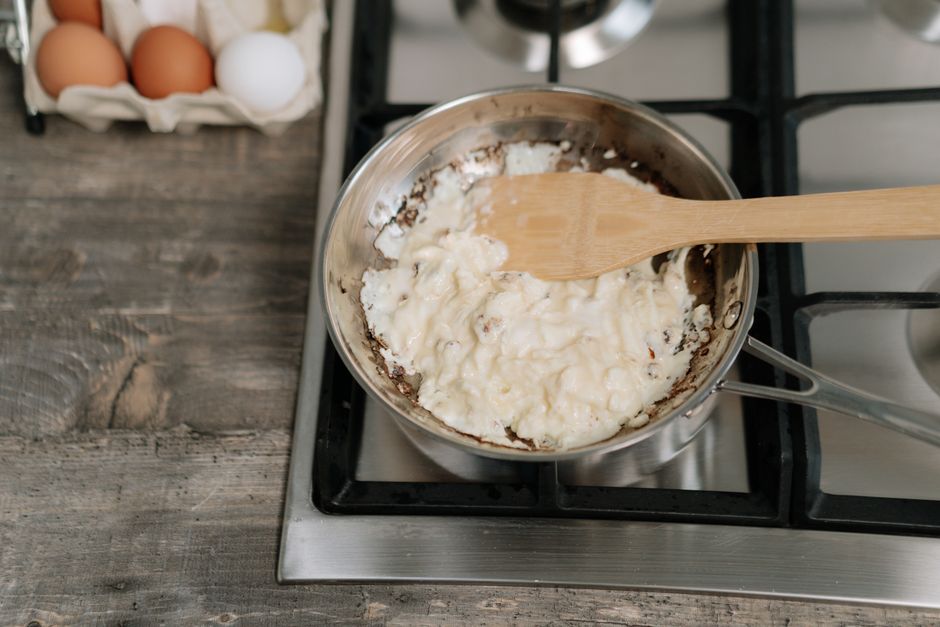
The short answer: Use 2 large eggs per person and 1 tablespoon milk or cream per 2 eggs. Whisk 20 to 30 seconds, cook on low-medium heat for about 3 to 5 minutes, and remove from heat when curds are still glossy so residual heat finishes them in 30 to 60 seconds.
Ingredients and equipment
For 2 servings use 4 large eggs, 2 tablespoons whole milk or 1 tablespoon heavy cream, 1 tablespoon unsalted butter, 1/2 teaspoon kosher salt, and 1/8 teaspoon freshly ground black pepper. For a richer finish add 1 to 2 tablespoons grated cheese. Scale by 2 eggs per person: 6 eggs serves 3, 8 eggs serves 4.
Pan size matters. Use an 8-inch nonstick skillet or a well-seasoned 8-inch cast-iron pan for 2 to 3 eggs; use a 10-inch pan for 4 to 6 eggs. If you cook 8 to 12 eggs, use a 12-inch pan and increase total cook time by 1 to 2 minutes.
Equipment list: a medium mixing bowl (about 2 cups capacity for 2 to 4 eggs), a small whisk or fork, a silicone spatula, measuring spoons (1 tablespoon = 15 ml), and a heatproof plate. For repeatable results, heat settings help: electric stovetop about 2 to 3 out of 10, gas on a low flame that still allows butter to foam in 10 to 20 seconds.
Room temperature eggs whisk more quickly and trap air better. Take eggs out of the fridge 5 to 10 minutes before cooking if time allows. Measure dairy precisely: 1 tablespoon per 2 eggs keeps curds tender without making them watery; avoid more than 1 tablespoon per 2 eggs unless you want a creamier, looser curd.
Quick technique tips
Ratios, pans, and heat that keep curds fluffy.
Foam, never brown
Butter must foam in 10 to 20 seconds; browning under 15 seconds means drop one notch and cool 20 seconds.
Whisk 20 to 30 seconds
Thirty to 40 strokes to 10 to 20 percent more volume; room-temp eggs from 5 to 10 minutes out trap air best.
Low and slow
- Electric 2 to 3 of 10, soft large curds
- Best for: tender custardy plates
- Rest 30 to 60 seconds carryover
Too hot and fast
- Rubbery sheets that weep water
- Best for: nothing but dry toast
- Back off at first browning
Cooking and finishing
Step 1: Crack and whisk. Crack 2 to 4 eggs into your bowl, add 1 tablespoon milk or cream per 2 eggs and 1/4 teaspoon kosher salt per 2 eggs, then whisk until uniform in color and slightly frothy, about 20 to 30 seconds (roughly 30 to 40 strokes). Aim to incorporate about 10 to 20 percent more volume—enough to see tiny bubbles but not a mousse.
Step 2: Preheat the pan. Put an 8-inch pan over low to medium-low heat for 20 to 30 seconds, then add 1 tablespoon butter. The butter should melt and foam within 10 to 20 seconds without browning; that foam signals the right temperature. If the butter browns in under 15 seconds, immediately lower the heat by one notch or remove briefly and let the pan cool for 20 seconds.
Step 3: Add eggs and manage motion. Pour the eggs into the warm pan and let them sit undisturbed for 5 to 10 seconds so a thin film sets on the bottom. Using a silicone spatula, push the set edges toward the center with wide sweeps every 10 to 15 seconds. Do 4 to 6 gentle folds during a 3 to 4 minute cook; this produces larger, tender curds instead of tiny, dry bits.
Step 4: Watch for the 70 percent cue. When the eggs look mostly set but still glossy and slightly runny, remove the pan from the heat; carryover will finish the last 10 to 20 percent in about 30 to 60 seconds. If you like cheese, fold in 1 to 2 tablespoons grated cheese now so it melts without releasing excess moisture.
Step 5: Plate and serve. Transfer eggs to a warm plate within 15 seconds of removing the pan to avoid steam-overcooking. Garnish with 1 teaspoon chopped chives or 1 tablespoon crème fraîche. Serve immediately—eggs are best within 2 minutes for optimal temperature and texture.
Scaling and timing for larger batches: for 6 eggs use a 10-inch pan and plan on 1 to 2 minutes extra cook time; for 10 to 12 eggs use a 12-inch pan and increase stirring cycles to 6 to 8 folds. Keep add-ins pre-cooked and warm; fold in 1/4 cup sautéed vegetables or 2 tablespoons cooked bacon at the end so total cook time stays under 7 minutes.
Troubleshooting: If eggs turn rubbery, you probably cooked at too-high heat or left them in the pan—reduce heat to low and remove when 70 percent set next time. If eggs are too runny, return the pan to very low heat and stir constantly for 20 to 30 seconds until they thicken, then remove immediately. For uneven curds, use wider strokes and fewer passes; aim for 4 to 6 pushes per batch.
Frequently Asked Questions
Further reading: How to Make Hummus Smoother Than Store-Bought · How to Make No-Knead Dutch Oven Bread for Beginners
Sources: FoodSafety.gov